No products in the cart.
Digital Transformation of Your IT Service
Outsourcing Through Our ZONE IBOSS Platform

Saudi manufacturers are moving toward connected, automated, and data-driven operations. National industrial priorities, smart infrastructure, and investment in advanced technologies are encouraging factories to improve productivity while increasing resilience, safety, and sustainability.
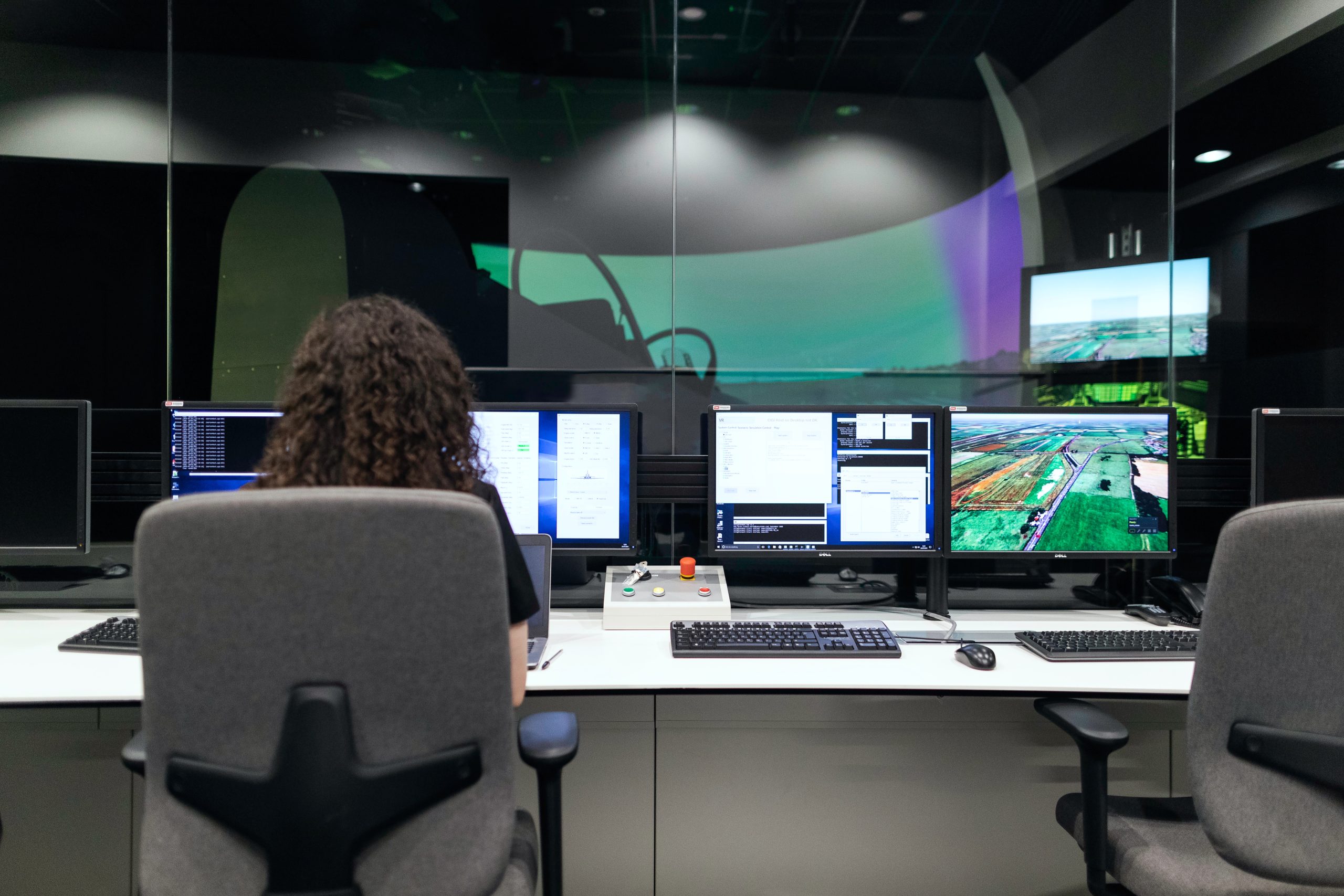
Digital twins and simulation provide a practical foundation for this progress. A digital twin is a dynamic virtual representation of a machine, production line, facility, or supply chain. It combines operational data, engineering models, and analytics so teams can observe current conditions, test scenarios, and make better decisions before changing the physical environment.
For companies pursuing digital transformation in Saudi manufacturing, the value lies in connecting strategy with execution. The technology can support plant design, predictive maintenance, energy management, quality control, and workforce planning when it is implemented with suitable data architecture and IT expertise.
A digital twin may begin with a single critical asset, such as a compressor, robotic arm, furnace, or packaging line. Sensors provide information about temperature, vibration, pressure, speed, and energy use. The model then compares real-time performance with expected behavior, helping engineers identify deviations before they become costly failures.
At a larger scale, a factory twin can represent material flow, production schedules, warehouse movement, and equipment utilization. Managers can simulate a new production mix, shift pattern, or maintenance window without interrupting live operations. This creates a safer environment for evaluating decisions that would otherwise require expensive physical trials.
Successful industrial simulation depends on reliable information from operational technology and enterprise systems. Sensors, programmable logic controllers, manufacturing execution systems, enterprise resource planning platforms, and maintenance applications must exchange data consistently. Clear ownership of data definitions is equally important, since different systems may use varying names, units, or timestamps.
A staged architecture helps organizations control complexity. Edge devices can process time-sensitive signals close to equipment, while cloud or private data platforms support long-term analysis and computationally intensive models. Application programming interfaces and integration services connect the twin to planning, maintenance, quality, and reporting workflows.
The result is more than a visual dashboard. A useful model explains relationships between events and outcomes. For example, it may show how a change in line speed affects energy consumption, product quality, maintenance intervals, and delivery commitments.
Digital twins can produce measurable benefits at several points in the industrial lifecycle. During design, simulation can test layout options, equipment capacity, and worker movement. During commissioning, a virtual model can help validate control logic and train operators. During production, it can support process optimization and early fault detection.
| Manufacturing area | Simulation and digital twin application | Potential business effect |
|---|---|---|
| Maintenance | Predict component failure from operating patterns | Less unplanned downtime |
| Quality | Model process conditions and identify defect drivers | More consistent output |
| Energy | Compare loads, schedules, and equipment settings | Lower consumption and emissions |
| Planning | Test capacity, product mix, and line balancing | Better delivery performance |
| Safety | Rehearse hazardous scenarios in a virtual environment | Safer procedures and training |
These benefits become stronger when models are linked to clear performance indicators. Saudi manufacturers may track overall equipment effectiveness, first-pass yield, maintenance cost, energy intensity, and order fulfillment. Connecting simulation results to these metrics helps decision-makers measure value instead of treating the twin as an isolated technology experiment.
A digital twin is only as dependable as the information feeding it. Poorly calibrated sensors, incomplete maintenance records, inconsistent master data, and unreliable network connections can produce misleading recommendations. Data validation should therefore be included in the implementation plan from the beginning.
Software quality is also essential where industrial systems interact with connected devices and smart infrastructure. Teams can apply structured test cases for device communication, interoperability, performance, security, and failure recovery. Guidance on IoT device testing is especially relevant when factory equipment connects to wider smart-city or industrial platforms.
Cybersecurity requires protection across sensors, gateways, applications, and user accounts. Manufacturers should define access controls, segment operational networks, monitor abnormal activity, and maintain recovery procedures. Simulation environments should also use controlled data, because an exposed model may reveal production capacity, equipment behavior, or supply chain dependencies.
Many factories already depend on legacy applications and databases. Replacing every system at once is rarely practical. A better approach is to identify the data required for the first use case, assess its quality, and establish secure interfaces before expanding the digital twin.
Migration testing should verify completeness, accuracy, transformation rules, performance, and business continuity. It should also confirm that historical records remain useful after moving between on-premises systems, private clouds, or public cloud services. Organizations planning this work can review cloud migration testing for relevant principles.
Implementation should include a pilot with a defined operational problem. For example, a manufacturer might begin by modeling a bottleneck line or a high-value asset. The team can compare baseline performance with results after deployment, refine the model, and create a repeatable pattern for additional plants.
A Saudi manufacturing organization can reduce risk by combining technical planning with operational ownership. Engineers, plant managers, IT teams, cybersecurity specialists, and business leaders should agree on the first measurable outcome before selecting platforms or sensors.
The following priorities provide a practical starting point:
A local technology partner can support requirements analysis, solution provider coordination, testing, integration, and change management. This is particularly useful when a project involves several vendors or must align with existing enterprise architecture and Saudi regulatory expectations.
Digital twins should be treated as an evolving capability rather than a one-time software purchase. Equipment changes, production recipes, business priorities, and regulatory requirements will affect the model over time. Regular validation ensures that simulations continue to reflect physical conditions and support current decisions.
With the right implementation approach, manufacturers can use virtual commissioning, predictive analytics, process optimization, and scenario planning as connected parts of their digital strategy. ZONE IBOSS helps organizations assess technology requirements, manage implementation partners, strengthen software quality, and connect transformation initiatives to practical business outcomes.
Start by identifying one production challenge where better data and simulation could deliver a measurable result. With expert planning and disciplined execution, that first use case can become the foundation for a broader, more resilient digital manufacturing environment in Saudi Arabia.
The “ZONE IBOSS” team of experts are fully prepared to provide immediate assistance to choose the best service and the best solution for your business today.